



Discovering cracks, dampness, water leaks or other problems in a property can leave homeowners wondering how serious the issue is and what needs to happen next. While some defects may be relatively minor, others can indicate underlying problems that require further professional investigation.
A building defect survey report helps property owners understand the condition of affected building elements, identify visible defects and make informed decisions about appropriate repairs or further investigations.
Whether you are dealing with structural cracking, persistent damp, roof deterioration or poor construction work, a professional defect survey can provide a clearer picture of what is happening and what action may be required.
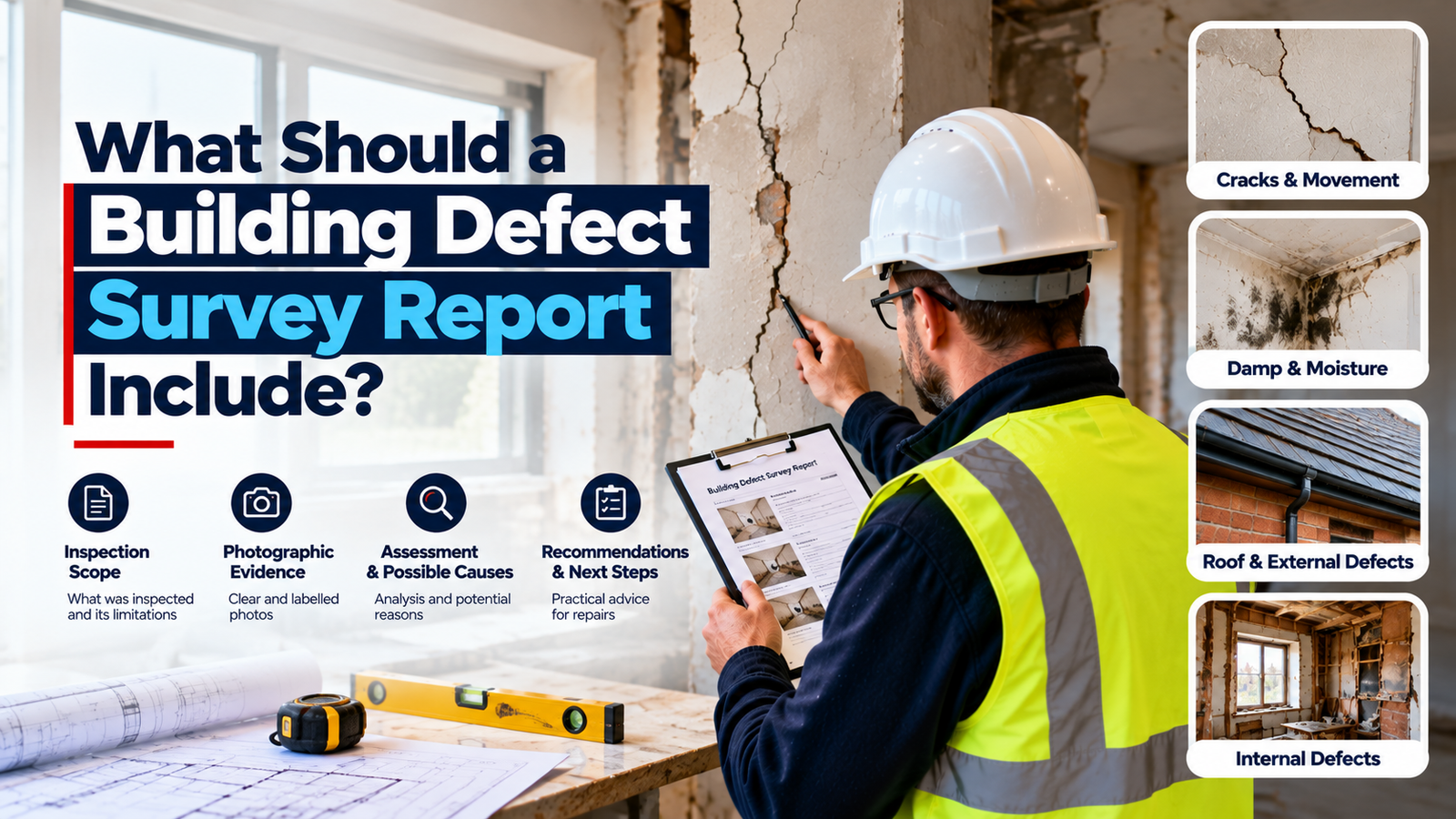
But what should you actually expect from a building defect survey report?
In this guide, we explain the essential sections of a professional report, the information a surveyor should provide and how to choose the right building defect survey in Essex or London.
1. Scope and Purpose of the Inspection
A professional building defect survey report should begin by explaining why the inspection was carried out and exactly what areas of the property were assessed.
Unlike a general building survey, which considers the overall condition of a property, a defect survey focuses on specific problems that require closer investigation.
For example, you might commission a survey because:
- Cracks have appeared in internal or external walls.
- Damp patches keep returning despite previous treatment.
- Water is entering through the roof or external walls.
- Floors appear uneven or show signs of movement.
- Building materials are deteriorating.
- Previous construction or renovation work has resulted in defects.
The report should identify the affected areas, explain the inspection approach and describe any limitations.
It should also make clear whether the inspection was visual and non-invasive or included additional testing.
This information is important because concealed structural elements, inaccessible areas and hidden defects may require separate investigations.
If you are dealing with a specific property problem in Essex, a professional Defect Survey in Essex can help establish the appropriate inspection scope.
2. Detailed Description and Location of Building Defects
One of the most important parts of a defect survey report is the description of the problems identified during the inspection.
Simply stating that a property has cracks, dampness or deterioration is not enough. The findings should explain where the defect is located and what was observed.
Depending on the nature of the problem, the report may include:
- Location of the affected building element.
- Visible size and extent of the defect.
- Crack patterns and measurements, where relevant.
- Condition of surrounding materials.
- Signs of moisture or deterioration.
- Areas showing previous repairs.
- Any visible changes or associated damage.
For example, if cracking is identified in an external wall, the report should describe its location, direction, visible pattern and relevant surrounding conditions.
Similarly, if dampness is observed, the report should identify the affected areas and describe the visible signs of moisture-related deterioration.
Clear descriptions help property owners, contractors and other professionals understand exactly what the surveyor found.
3. Photographic Evidence and Supporting Observations
Photographs are an important part of a professional building defect survey report because they provide a visual record of the property’s condition at the time of inspection.
A well-prepared report should include relevant photographs that support the surveyor’s written findings.
Depending on the inspection, these may show:
Structural Cracks: Images showing cracks in walls, ceilings, masonry and other building elements.
Damp and Moisture: Photographs of damp patches, staining, mould growth and damaged plasterwork.
Roofing Defects: Images of damaged roof coverings, defective flashing, gutters and visible water ingress.
Timber Deterioration: Photographs showing signs of timber decay, deterioration or suspected infestation.
Poor Workmanship: Images documenting defective finishes, construction details or previous repairs.
Photographs should be clearly labelled and connected to the relevant observations in the report.
This makes it easier to understand the findings without having to interpret every photograph independently.
4. Assessment of Defects and Their Possible Causes
Identifying a defect is only part of the inspection. Understanding why it has occurred is often the more important question.
A professional surveyor should assess the available evidence and explain the possible causes of the problems identified.
For example:
Structural Cracking
Cracking may be associated with building movement, thermal changes, settlement, poor workmanship or deterioration of building materials.
The surveyor should consider the pattern, position and surrounding condition before discussing possible explanations.
Dampness and Water Ingress
Moisture-related defects may result from leaking pipes, defective roofing, penetrating moisture, condensation or other sources of water entry.
Identifying the likely mechanism is important because different causes require different solutions.
Roof and External Defects
Water penetration may occur because of damaged tiles, defective flashing, blocked gutters or deteriorating roof membranes.
The report should describe the observed condition and identify areas that may require further investigation.
Timber Decay
Timber deterioration may be associated with prolonged moisture exposure, inadequate ventilation or fungal decay.
Where the extent of the problem cannot be established visually, further specialist investigation may be recommended.
Importantly, a surveyor should distinguish between confirmed observations and possible explanations. A visual inspection does not automatically establish the exact cause of every defect.
Where further testing or specialist expertise is required, the report should explain this clearly.
5. Severity, Risks and Potential Consequences
Another important part of a building defect survey report is understanding the significance of the findings.
Not every defect presents the same level of concern. Some issues may require routine maintenance, while others may need prompt professional attention.
A report should explain the apparent significance of the defect based on the evidence available.
For example:
| Defect | Potential Concern |
|---|---|
| Minor plaster cracking | Cosmetic deterioration or movement requiring monitoring |
| Significant structural cracking | Possible structural movement requiring further assessment |
| Persistent dampness | Material deterioration and potential mould growth |
| Roof leakage | Water damage to internal building elements |
| Timber decay | Progressive deterioration of affected timber |
| Defective external masonry | Water penetration and further deterioration |
Where a defect raises safety concerns, the report should explain the urgency of appropriate action.
If structural stability is in question, a qualified structural engineer may need to carry out a separate assessment.
6. Recommendations for Repairs and Further Investigation
A useful defect survey report should not simply identify problems. It should help the property owner understand what to do next.
Recommendations should be practical and appropriate to the findings.
Depending on the defect, these may include:
- Routine maintenance and repair.
- Further investigation of suspected structural movement.
- Specialist damp or moisture assessment.
- Inspection by a roofing contractor.
- Timber specialist investigation.
- Structural engineering advice.
- Monitoring of cracks or other changes.
- Preparation of a detailed repair specification.
The report should also distinguish between immediate concerns and issues that can be addressed through planned maintenance.
It is important to remember that detailed repair specifications, structural calculations and cost estimates are not automatically included in every defect survey. These should be agreed separately where required.
If you need a targeted inspection of a specific building problem, explore Structura Surveying’s Defect Survey Services in London.
7. Inspection Limitations and Areas Requiring Further Assessment
A professional report should explain what could and could not be inspected.
This is particularly important when certain parts of the property are concealed, inaccessible or unsafe to examine.
Examples include:
- Hidden structural elements.
- Areas behind fitted kitchen units.
- Concealed pipework.
- Roof spaces with restricted access.
- Components covered by internal finishes.
- Foundations that cannot be inspected without excavation.
A visual inspection cannot confirm the condition of every concealed building element.
The report should explain these limitations and identify where additional investigations may be necessary.
Understanding these boundaries helps property owners avoid treating a survey report as a guarantee that no other defects exist.
8. Professional Presentation and Clear Reporting
The quality of the written report matters just as much as the inspection itself.
A professional building defect survey report should be easy to follow, properly organised and written in language that property owners can understand.
Look for the following features:
- Clear property and inspection details.
- A defined inspection scope.
- Numbered findings and defect descriptions.
- Relevant photographs.
- Supporting measurements where appropriate.
- Explanation of possible causes.
- Clear reporting limitations.
- Practical recommendations.
- Identification of further specialist requirements.
The report should avoid unnecessary technical jargon and explain important surveying terms where needed.
This is particularly useful when sharing the findings with contractors, solicitors, property managers or other professionals.
How to Choose the Right Building Defect Surveyor
Choosing a surveyor is an important decision, particularly when the property has significant or recurring defects.
Before booking, consider the following factors.
Check Qualifications and Professional Experience
Ask about the surveyor’s qualifications, professional membership and experience with the specific type of building defect you are dealing with.
For more complex problems, relevant experience in structural movement, dampness, roofing or construction defects may be particularly important.
Confirm What the Inspection Includes
Before commissioning the survey, ask which areas will be inspected, whether photographs are included and what level of assessment will be provided.
Make sure the service addresses the specific concerns you want investigated.
Ask About the Final Report
Find out whether the report includes written findings, photographs, possible causes, limitations and recommendations for further action.
If you need repair cost estimates or a Schedule of Works, confirm whether these are included or require a separate instruction.
Understand the Fees and Timescale
Ask for a clear quotation and estimated report delivery date.
The cost will depend on the property, the complexity of the defects and the scope of the inspection.
Avoid choosing a survey solely because it has the lowest fee. The quality and relevance of the inspection are more important.
Why Choose Structura Surveying for Building Defect Surveys?
When building defects affect your property, receiving clear professional advice can make a significant difference to your next decisions.
Structura Surveying provides specialist defect surveying services for property owners who need help understanding building problems and identifying appropriate next steps.
Its defect survey services cover issues such as:
- Structural cracking and building movement.
- Dampness and water ingress.
- Roof and external building defects.
- Timber deterioration.
- Poor construction and workmanship.
- Defects associated with extensions and alterations.
Property owners can explore Defect Surveys in Essex and Defect Surveys in London to find the relevant inspection service.
For situations requiring a broader assessment of the property’s overall condition, Structura Surveying also provides Building Surveys in Essex.
The appropriate service depends on the property, the problem and the level of investigation required.
What Makes a Good Building Defect Survey Report?
A good building defect survey report should provide a clear and structured understanding of the problems identified during an inspection.
It should explain the inspection scope, describe visible defects, include relevant photographic evidence, discuss possible causes and recommend appropriate next steps.
Just as importantly, it should identify any limitations and explain when additional specialist investigation is required.
Whether you are dealing with structural cracking, dampness, water ingress or poor construction work, choosing the right defect survey can help you make more informed decisions about your property.
If you need professional advice about building defects, explore Structura Surveying’s Defect Survey Services in Essex and London.
Contact Structura Surveying to discuss your property concerns and arrange an inspection suited to your requirements.
Frequently Asked Questions
1. What should a building defect survey report include?
A professional report should include the inspection scope, descriptions of identified defects, relevant photographs, possible causes, assessment of their significance, inspection limitations and recommendations for further investigation or repairs.
2. Does a defect survey report identify the exact cause of every problem?
Not always. Some defects require specialist testing, monitoring or invasive investigation. A surveyor should explain what can be established from the available evidence and where further investigation is necessary.
3. Will a building defect survey report include photographs?
Photographs are commonly included to document visible defects and support the written findings. Confirm the photographic reporting arrangements with the surveyor before booking.
4. Does a building defect survey include repair costs?
Not automatically. Some services provide general recommendations, while detailed repair specifications, contractor pricing and Schedules of Works may require a separate instruction.
5. How long does it take to receive a defect survey report?
The timescale depends on the inspection’s complexity, the amount of reporting required and whether further investigation is needed. Ask the surveyor for an estimated delivery date when arranging the inspection.
6. Can a defect survey report be used for an insurance claim?
A defect survey report may provide technical information and photographic evidence to support an insurance claim. However, the insurer determines coverage and settlement under the policy terms.
7. What is the difference between a building survey and a defect survey?
A building survey assesses the general condition of a property, while a defect survey focuses on specific problems that require more detailed investigation, such as cracking, dampness or water ingress.
8. Should I arrange a defect survey before carrying out repairs?
For significant or recurring defects, obtaining a professional assessment before permanent repairs can help identify the underlying problem and avoid inappropriate remedial work. Emergency work should not be delayed where necessary for safety or to prevent further damage.