



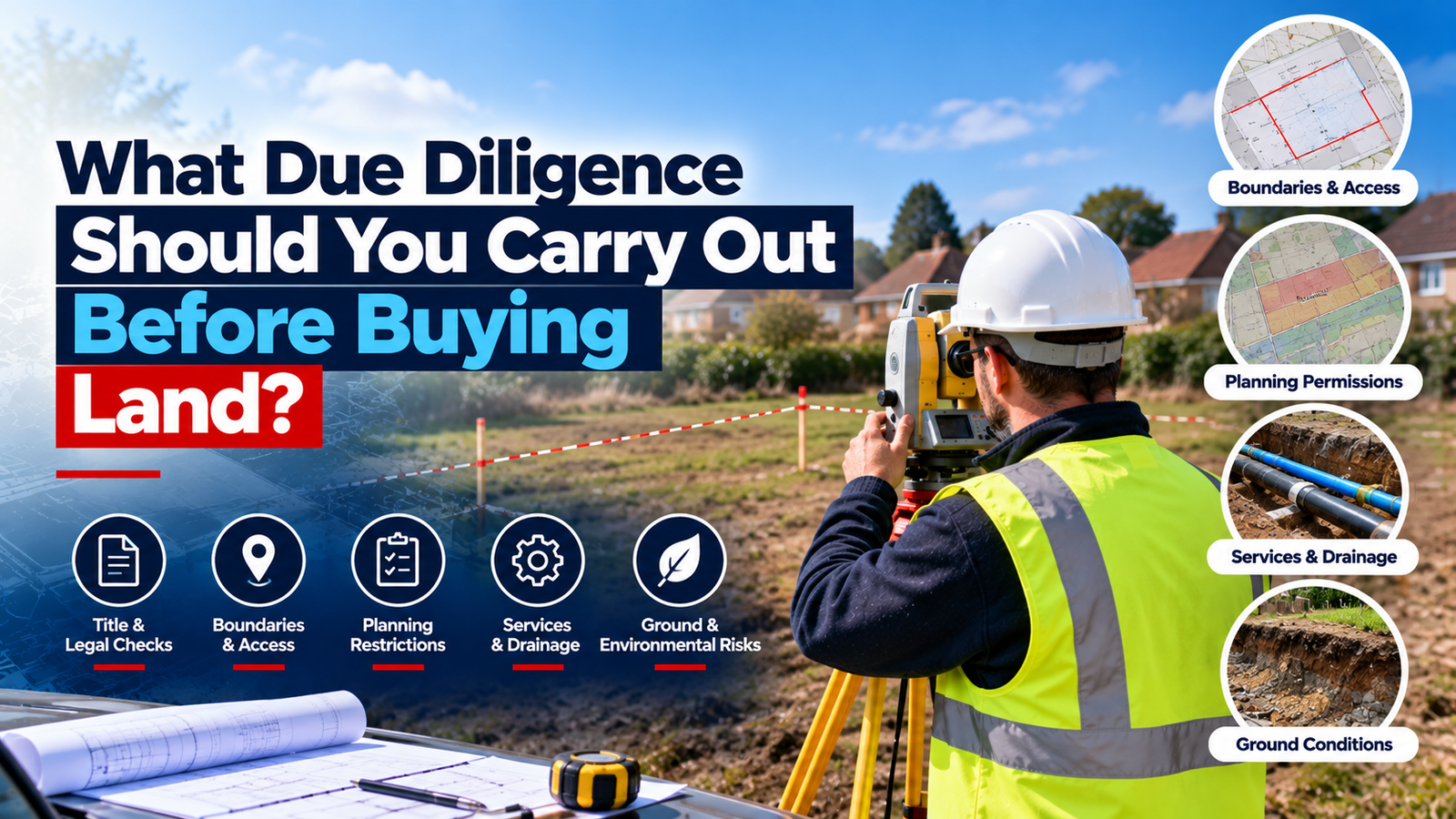
Buying land can be a significant investment, but assessing a plot involves more than checking its size, location and asking price. Unclear boundaries, restricted access, planning limitations, drainage problems and environmental risks can all affect how land can be used.
Carrying out proper due diligence before buying land helps you identify potential issues, understand the property’s limitations and make a more informed purchasing decision.
Unlike buying a conventional residential property, purchasing land may require several different investigations. These can include a land survey, legal title checks, planning enquiries, environmental assessments and specialist technical reports.
No single inspection covers every potential risk. The right approach depends on the location of the land, its existing condition and what you intend to do with it.
1. Establish What You Intend to Do With the Land
Before purchasing a plot, clearly define its intended use. Land purchased for residential development may require different checks from land intended for agriculture, commercial use, investment or future redevelopment.
Do not assume that a plot can automatically be developed because neighbouring properties have buildings on them.
Consider the following questions:
- Is the land allocated or designated for a particular use?
- Does the existing planning status support your intended project?
- Are there restrictions that could prevent development?
- Does the site have suitable road access?
- Are essential utilities available nearby?
- Could environmental or ground conditions affect construction?
A planning consultant or the relevant local authority can help assess planning matters. Your solicitor should review legal restrictions, while surveyors and technical specialists can investigate the physical characteristics of the site.
Understanding your intended use early helps determine which professional investigations are necessary.
2. Review the Land Title and Legal Restrictions
One of the most important steps when buying land is reviewing its legal title.
Ask your conveyancing solicitor to examine the title register, title plan and relevant supporting documents. These may contain information about ownership, rights, restrictions and responsibilities affecting the land.
Pay particular attention to:
- Restrictive covenants that may limit how the land can be used.
- Easements and rights of way affecting access or services.
- Rights granted to neighbouring property owners.
- Maintenance responsibilities relating to shared routes or facilities.
- Charges, notices or other registered interests.
- Restrictions relating to development or alterations.
The legal implications of these documents depend on their wording and circumstances. A solicitor should explain how they may affect your intended purchase.
A physical land inspection cannot replace legal title advice. However, a surveyor may help document visible site features and compare physical evidence with available plans within the agreed survey scope.
3. Investigate Property Boundaries and Physical Access
Unclear boundaries can create problems for land buyers, particularly where fences, hedges, walls or access routes do not appear to match available plans.
Before proceeding, compare the available title information with the physical features on the ground. Record any uncertainty about the position of boundary markers, neighbouring structures or access routes.
It is important to understand that Land Registry title plans generally show general boundaries rather than guaranteeing the exact position of every boundary line.
If the precise boundary position is important to the purchase, consider obtaining professional boundary surveying advice.
A boundary survey may involve:
- Reviewing title deeds and relevant property documents.
- Examining Land Registry plans and historical mapping.
- Inspecting visible boundary features.
- Taking appropriate site measurements.
- Comparing physical evidence with documentary information.
- Preparing a professional report within the agreed scope.
Access should also be investigated carefully. Check whether the plot has a recognised legal right of access or whether access depends on a private road, shared driveway or neighbouring land.
A visible track or existing gate does not automatically establish a legal right of access. Your solicitor should confirm the relevant legal position.
For further information, read our guide on how surveyors prove boundary lines in Essex and London.
4. Check Planning Permission and Development Restrictions
If you intend to build on the land, planning considerations should form an important part of your due diligence.
A plot may appear suitable for development but still be affected by planning restrictions, local policies or site-specific constraints.
Investigate:
- Existing planning permissions and conditions.
- Local planning policies and land-use designations.
- Conservation area restrictions, where applicable.
- Listed building or protected site considerations.
- Tree preservation orders.
- Ecological restrictions and protected habitats.
- Access, parking and highway requirements.
- Potential restrictions on building size, position or use.
Planning permission granted for neighbouring land does not guarantee approval for your proposed development.
Contact the relevant local planning authority or a qualified planning consultant to understand the planning position. Where necessary, obtain professional advice before relying on a particular development proposal when valuing or purchasing the plot.
5. Assess Drainage, Utilities and Ground Conditions
A plot may be attractive in terms of location and size but still present practical challenges if essential services are unavailable or difficult to connect.
Before buying, investigate the availability and feasibility of connecting:
- Mains water.
- Electricity.
- Gas, where available.
- Telecommunications and broadband.
- Foul drainage.
- Surface water drainage.
Ask whether existing connections are confirmed or whether new infrastructure will be required. Also investigate whether utility routes depend on easements or access across neighbouring land.
Ground conditions are another important consideration, particularly where construction is planned.
Depending on the site, specialist investigations may be required to assess:
- Soil composition and bearing capacity.
- Ground stability and potential movement.
- Groundwater conditions.
- Flooding and surface water risks.
- Contamination from previous land uses.
- Potential drainage limitations.
A general land survey does not automatically include geotechnical testing, contamination assessment or a detailed drainage investigation. Confirm the scope of each proposed report before commissioning it.
6. Consider Environmental Risks and Contaminated Land
Environmental due diligence is particularly important where land has previously been used for industrial, commercial or other potentially contaminating activities.
Past land use can sometimes leave contamination or environmental conditions that affect future development.
Depending on the location and proposed use, investigate:
- Previous industrial or commercial activities.
- Potential soil and groundwater contamination.
- Flood risk and surface water exposure.
- Nearby landfill or waste management sites.
- Protected habitats and ecological constraints.
- Ground stability and other environmental hazards.
- Relevant local authority environmental records.
An environmental report can help identify potential concerns and determine whether additional investigation is necessary.
Structura Surveying provides access to Environmental Reports through its specialist partner Geosearch Solutions. These assessments can support contaminated land and environmental due diligence when purchasing or developing property.
The appropriate level of investigation will depend on the site history, location, intended use and any planning requirements.
7. Arrange an Appropriate Land Survey
A professional land survey can help you understand the physical characteristics of a plot and identify features that may affect your purchase or proposed development.
The type of survey should be selected according to the questions you need answered.
Depending on the instruction, surveying work may help establish:
- Site dimensions and physical layout.
- Visible boundary features.
- Ground levels and changes in elevation.
- Existing structures and site features.
- Access routes and physical obstructions.
- The relationship between physical features and available plans.
A measured or topographical survey may be appropriate where detailed site information is required for design or development planning. A boundary survey may be more suitable where the position of a boundary is uncertain.
The surveyor should confirm exactly what will be measured, what information will be supplied and which matters are outside the inspection scope.
Read our guide on what happens during a land survey to understand the general process.
8. Coordinate Advice From the Right Professionals
Buying land can involve several separate areas of expertise. Relying on one professional to check every issue can leave important questions unanswered.
Depending on the property and your intended use, consider involving:
Conveyancing solicitor: Reviews ownership, title documents, restrictive covenants, easements and legal access rights.
Land surveyor: Provides physical site information, measurements and boundary-related evidence within the agreed scope.
Planning consultant: Advises on planning policies, development potential and relevant planning restrictions.
Environmental specialist: Investigates contamination and environmental risks where required.
Geotechnical engineer: Assesses ground conditions, soil characteristics and foundation-related considerations.
Drainage specialist: Investigates drainage capacity, connections and potential site drainage problems.
Ask each professional to confirm the scope of their work, expected deliverables, fees and any exclusions.
Maintain a written list of outstanding questions and make sure significant issues are investigated before committing to the purchase where possible.
Land Purchase Due Diligence Checklist
Use this checklist to organise the main investigations before purchasing a plot.
Legal and Documentation Checks
- Review the title register and title plan.
- Ask your solicitor to check restrictive covenants.
- Investigate easements and rights of way.
- Confirm legal access arrangements.
- Review relevant planning history and conditions.
- Identify any registered restrictions or interests.
Physical and Survey Checks
- Compare available plans with physical site features.
- Investigate unclear boundaries.
- Consider an appropriate land or topographical survey.
- Check access routes and visible site constraints.
- Identify existing structures and potential obstructions.
- Review available information about ground conditions.
Environmental and Development Checks
- Investigate potential contamination risks.
- Review relevant flood risk information.
- Check drainage and utility availability.
- Consider ecological or protected-site restrictions.
- Assess planning suitability for the intended use.
- Obtain additional technical reports where necessary.
Professional Advice
- Appoint a suitable conveyancing solicitor.
- Confirm the required survey scope.
- Consult a planning professional if development is intended.
- Obtain environmental or engineering advice where appropriate.
- Resolve significant outstanding questions before proceeding.
How Structura Surveying Can Help With Land Due Diligence
Understanding the physical characteristics and boundaries of land can be an important part of the purchase process.
Structura Surveying provides professional surveying services across Essex and London, including boundary-related assessments, building surveys and access to environmental reporting services.
Depending on your requirements, professional surveying input may help you understand site features, investigate boundary uncertainty and identify where further technical advice is needed.
Explore our Boundary Dispute Survey services or learn more about our Environmental Reports to understand the available support.
For a wider overview of the surveying options available, visit our surveying services page.
Conclusion
Carrying out due diligence before buying land is essential for understanding what you are purchasing and whether the plot is suitable for your intended use.
Review the legal title with your solicitor, investigate boundaries and access, assess planning restrictions and consider environmental, drainage and ground conditions where relevant.
The most effective approach is to identify the questions that matter to your purchase and commission the appropriate professional advice to answer them.
By investigating potential risks before committing, you can make a more informed decision and reduce the likelihood of unexpected problems during ownership or development.
Frequently Asked Questions
Should I commission a land survey before buying land?
A land survey can be useful when site dimensions, physical features, boundaries or ground levels are important to your purchase. The appropriate survey depends on the plot and your intended use.
Does a land survey check legal title?
Generally, no. A land survey examines physical site information within its agreed scope. Your conveyancing solicitor should review title documents, ownership, covenants and legal rights.
Can a surveyor confirm the exact legal boundary of land?
A surveyor can examine relevant documents, physical evidence and measurements to provide a professional boundary opinion within the agreed scope. The legal position may require further advice from a solicitor or formal resolution.
How do I check whether land has legal access?
Ask your conveyancing solicitor to review the title documents and any relevant rights of way or easements. Physical access alone does not necessarily establish a legal right to use a route.
Can I build on land without planning permission?
Whether development requires planning permission depends on the proposed work, land use and applicable planning rules. Check with the local planning authority or a qualified planning consultant before proceeding.
What is an environmental report when buying land?
An environmental report assesses potential environmental risks associated with a site. Depending on its scope, it may identify concerns such as contaminated land, flood risk or other environmental constraints.
Who should I contact if land boundaries are unclear?
A suitably experienced boundary surveyor can investigate physical and documentary evidence. Your solicitor can advise on the legal implications and any conveyancing or dispute-related matters.
What is the most important check before buying land?
There is no single check that is most important for every purchase. Title, access, planning, boundaries, environmental conditions and ground suitability should be assessed according to the intended use and specific risks of the plot.