


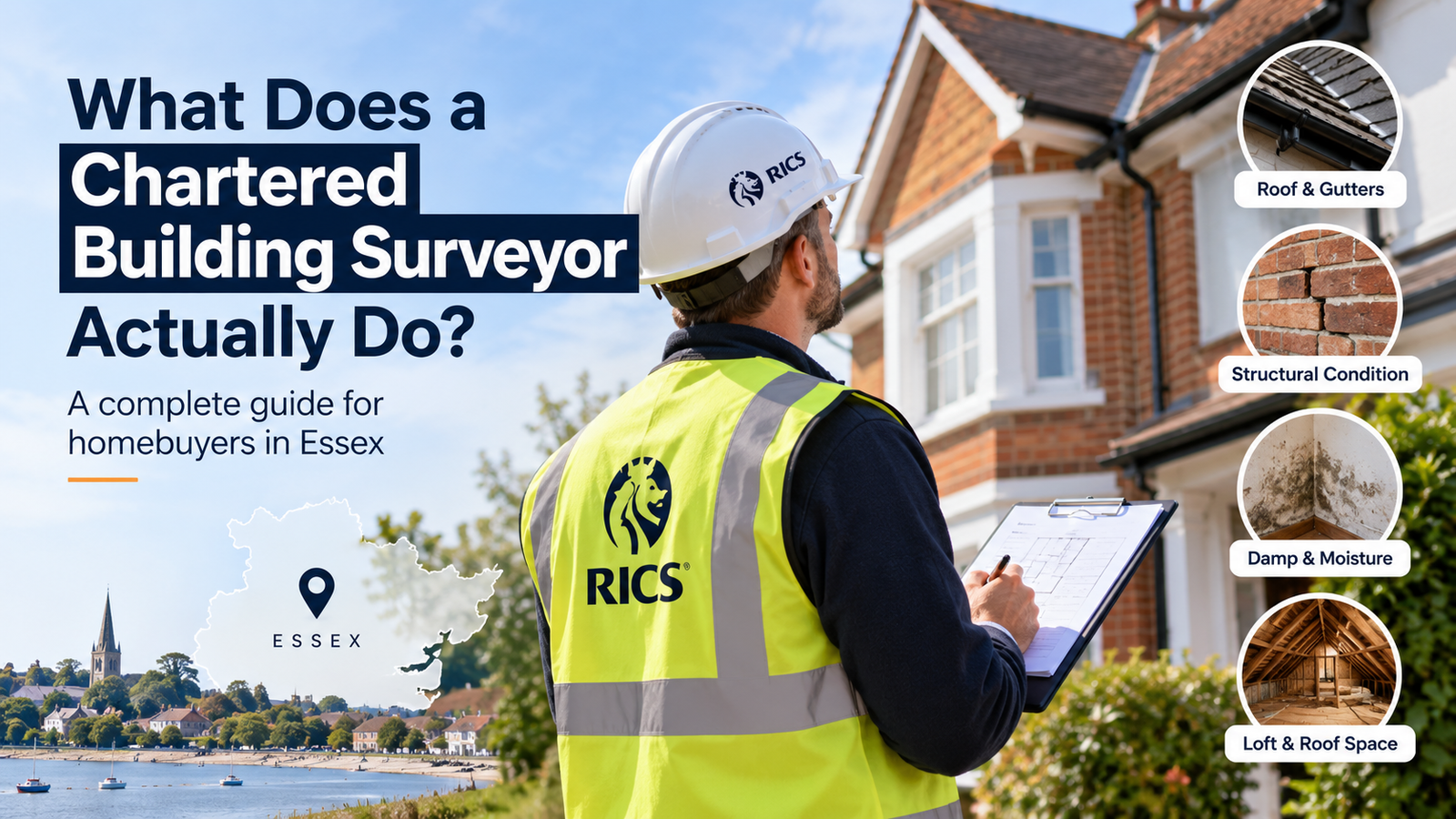
If you’re buying a property in Essex, getting the right building survey can help you understand the condition of the property before you commit to the purchase. But what does a chartered building surveyor actually do?
A chartered building surveyor carries out a professional inspection of a property’s condition, identifies visible defects and potential risks, and provides advice to help you make an informed decision. Depending on the type of survey, this can include looking at the roof, walls, floors, windows, damp, structural movement, drainage, loft spaces and other accessible parts of the building.
For buyers in Essex, choosing an experienced chartered building surveyor in Essex can be particularly useful when purchasing an older, altered, unusual or potentially defective property.
What Is a Chartered Building Surveyor?
A chartered building surveyor is a property professional who has achieved chartered membership with the Royal Institution of Chartered Surveyors (RICS) or works within an appropriately regulated RICS firm.
RICS sets professional standards for surveying services and provides different levels of residential home surveys. Its current home survey framework includes RICS Home Survey Level 1, Level 2 and Level 3.
When choosing a surveyor, you can check whether an individual is an active RICS professional through the RICS member database.
Common RICS membership designations include:
- AssocRICS – Associate member of RICS
- MRICS – Chartered Member of RICS
- FRICS – Fellow of RICS
It’s important to check the surveyor’s actual membership status rather than relying solely on wording used on a company’s website.
What Does a Building Surveyor Do?
The main role of a building surveyor is to assess the physical condition of a property and report their findings to the client.
Depending on the survey level and property, an inspection may consider:
- Roof coverings and roof structure
- Chimneys and external walls
- Brickwork and masonry
- Windows and external doors
- Floors and ceilings
- Signs of damp or moisture
- Cracks and possible structural movement
- Loft and roof spaces
- Drainage and accessible inspection chambers
- Extensions and alterations
- External areas and outbuildings
- Visible defects requiring further investigation
- Maintenance and repair requirements
The surveyor then documents relevant findings in a written report.
The exact scope depends on the RICS Home Survey level selected and the property’s characteristics. RICS states that different survey levels provide different depths of inspection and reporting.
What Happens During a Property Survey?
A typical residential property survey begins with an inspection of the accessible parts of the building.
1. External Inspection
The surveyor may inspect visible external elements such as:
- Roof coverings
- Gutters and rainwater pipes
- Chimneys
- External walls
- Brickwork and pointing
- Windows and doors
- Drainage
- Paths, boundaries and other external features
The surveyor will look for signs of deterioration, movement, damp and other defects that may require attention.
2. Internal Inspection
Inside the property, the surveyor may examine:
- Walls
- Ceilings
- Floors
- Windows
- Doors
- Staircases
- Fireplaces
- Visible services
- Signs of damp
- Cracking or movement
The inspection is primarily visual, and the extent of inspection depends on the survey level.
3. Loft and Roof Space
Where access is available and safe, the surveyor may inspect the loft or roof space.
This can help identify issues such as:
- Roof leaks
- Damaged or altered timbers
- Poor ventilation
- Insulation issues
- Signs of moisture
- Structural concerns
RICS Level 2 and Level 3 surveys provide more extensive inspection than Level 1.
4. Identifying Defects
One of the most important parts of a building survey is identifying defects and explaining their significance.
A surveyor may identify issues such as:
- Damp
- Timber deterioration
- Cracking
- Roof defects
- Defective pointing
- Drainage concerns
- Poor alterations
- Movement
- Defective render
- Problems associated with extensions
Where further investigation is required, the report can recommend appropriate next steps.
What Are the RICS Home Survey Levels?
Not every property needs the same level of inspection.
RICS currently provides three main Home Survey levels for residential properties:
RICS Home Survey Level 1
Level 1 is the most basic survey option.
It provides an overview of the property’s condition, identifies visible defects and highlights relevant risks. RICS describes it as being more suitable for conventional, modern properties in satisfactory condition. It does not provide detailed repair or maintenance advice.
RICS Home Survey Level 2
Level 2 provides a more detailed inspection than Level 1.
It is generally suitable for conventional properties in reasonable condition that are relatively straightforward in construction and layout.
Depending on the option selected, Level 2 can be:
- RICS Home Survey Level 2 – Survey Only
- RICS Home Survey Level 2 – Survey and Valuation
The Level 2 survey provides more information about defects, maintenance and repairs than Level 1.
RICS Home Survey Level 3
Level 3 is the most comprehensive RICS residential survey.
It is generally more appropriate for:
- Older properties
- Large properties
- Properties in poor condition
- Unusual buildings
- Properties with significant alterations
- Properties where major works are planned
- More complex buildings
The Level 3 survey provides a much more detailed assessment of construction, defects, repair options and maintenance requirements. RICS notes that Level 3 was previously known as an RICS Building Survey.
Which Survey Level Should You Choose?
There isn’t one survey level that is right for every property.
The appropriate level can depend on factors including:
- Property age
- Size
- Condition
- Construction
- Alterations
- Extensions
- Complexity
- Your plans for the property
RICS recommends discussing your requirements with a surveyor so the inspection level matches the property and your needs.
Why Choose a Chartered Building Surveyor in Essex?
Local knowledge can be useful when assessing properties across Essex.
Essex includes a mixture of modern housing developments, older properties, rural homes, coastal locations and properties that have been extended or altered over the years.
Depending on the location and property, a surveyor may need to consider issues such as:
- Ground conditions
- Possible clay-related movement
- Local flood risk
- Older construction methods
- Damp and moisture-related problems
- Extensions and alterations
- Condition of older building materials
However, local knowledge should complement, rather than replace, a proper inspection of the individual property.
For this reason, when searching for a building surveyor in Essex, it is worth asking whether they regularly inspect properties similar to yours.
Why Experience Matters When Choosing a Building Surveyor
RICS membership provides an important professional benchmark, but experience with the type of property you’re buying can also be valuable.
Before appointing a surveyor, consider asking:
- How much experience do you have with residential surveys?
- Do you regularly survey properties in Essex?
- Have you inspected properties of a similar age?
- Do you have experience with older or traditional buildings?
- Have you surveyed properties with extensions or alterations?
- What survey level would you recommend for this property?
- Can I see an example of your report?
- What happens if I have questions after receiving the report?
A useful survey report should explain findings clearly rather than simply listing defects.
How Much Does a Building Survey Cost in Essex?
The cost of a property survey varies depending on several factors, including:
- Survey level
- Property size
- Property value
- Age and condition
- Location
- Complexity
- Additional services required
Rather than relying on a generic price range, it is better to obtain a written quotation based on the actual property.
When comparing quotes from chartered building surveyors Company in Essex, check exactly what is included in the service and which RICS survey level will be provided.
The cheapest quote is not necessarily the most appropriate option if a property requires a more detailed inspection.
What Should You Check Before Hiring a Surveyor?
Before booking a building survey, use this checklist:
1. Check Their RICS Status
Use the official RICS member database to verify the surveyor’s professional status.
2. Check Professional Indemnity Insurance
Ask whether appropriate professional indemnity insurance is in place.
3. Ask About Relevant Experience
Find out whether the surveyor regularly works on properties similar to yours.
4. Confirm the Survey Level
Make sure your quotation clearly states whether you are receiving a Level 1, Level 2 or Level 3 Home Survey.
5. Request a Sample Report
A sample report can help you understand how detailed and easy to follow the final document is.
6. Check the Timescale
Ask when the inspection will take place and when you should expect the report.
7. Ask About Follow-Up Questions
Find out whether you can contact the surveyor after receiving the report if you need clarification.
Common Mistakes When Buying a Property in Essex
Relying Only on a Mortgage Valuation
A mortgage valuation is not the same as a detailed building survey.
Its purpose is generally connected with the lender’s assessment of the property and its value. It should not be treated as a substitute for an independent survey of the property’s condition.
Choosing the Cheapest Survey
Price is important, but the appropriate survey level and the surveyor’s experience should also be considered.
Choosing the Wrong Survey Level
A basic survey may not provide the depth of information you need for an older, altered or unusual property.
Not Checking the Surveyor
Always verify relevant professional credentials and make sure you understand who is carrying out the inspection.
Ignoring Defects Identified in the Report
If a survey identifies a potentially significant defect, don’t simply ignore it.
Depending on the issue, you may need specialist advice, further investigation, repair estimates or additional information before proceeding with the purchase.
Can a Building Survey Help With Price Negotiation?
Potentially, yes.
If a survey identifies significant defects or future repair requirements, the information may help you discuss the purchase with the seller.
For example, you may decide to:
- Request further investigations
- Obtain repair quotations
- Reconsider the offer
- Ask the seller to address specific issues
- Continue with the purchase while budgeting for future repairs
The survey itself does not determine the price you should offer. Instead, it provides information that can form part of your wider purchasing decision.
What Happens After the Survey?
Once the inspection is complete, the surveyor prepares the relevant report.
The report should help you understand:
- The property’s condition
- Significant visible defects
- Areas requiring attention
- Potential risks
- Recommended further investigations
- Maintenance requirements
- Repair considerations, where applicable
The exact information included depends on the survey level.
RICS states that its Home Survey reports are designed to provide a clear, structured assessment and help clients understand issues that may need attention.
If you are unsure about something in the report, speak to your surveyor before making important decisions about the property.
Frequently Asked Questions About Chartered Building Surveyors in Essex
What is a chartered building surveyor?
A chartered building surveyor is a qualified surveying professional who has achieved chartered membership with RICS or works within an appropriately regulated RICS firm. They can provide professional property inspection and surveying services within their area of competence.
What does a building surveyor check?
Depending on the survey level, a building surveyor may inspect accessible parts of the roof, walls, floors, ceilings, windows, roof space, drainage and other elements of the property. The scope varies between RICS Home Survey Levels 1, 2 and 3.
Is a Level 3 Building Survey the same as an RICS Building Survey?
The terminology has changed. The current RICS service is called an RICS Home Survey Level 3 and was previously known as an RICS Building Survey. It provides the most comprehensive of the three RICS Home Survey levels.
Which RICS survey is best for an older property?
Older, larger, unusual, altered or run-down properties may be more suitable for a Level 3 Home Survey because it provides a more comprehensive inspection and greater detail about defects, repairs and maintenance. The appropriate survey should be discussed with the surveyor based on the individual property.
How long does a building survey take?
The inspection time varies according to the property’s size, condition, complexity and the level of survey being undertaken. Your surveyor should explain the expected inspection and reporting timescale before the appointment.
Can a building surveyor identify structural problems?
A surveyor can identify visible signs that may indicate structural movement or other building defects. Where a specialist structural investigation is required, the surveyor may recommend further assessment by an appropriately qualified professional.
Can a building survey help me negotiate the property price?
A survey can provide useful information about defects and potential repair costs that you can consider when discussing the purchase with the seller. It does not, however, determine what price you should offer.
How can I find a chartered building surveyor in Essex?
Start by checking the surveyor’s professional credentials and relevant experience. RICS provides a member search facility where you can check active qualified RICS professionals.
A chartered building surveyor in Essex can provide valuable information about a property’s condition before you commit to buying it.
From identifying visible defects and potential structural concerns to explaining maintenance requirements and recommending further investigation, a professional survey can help you understand the risks associated with a property.
The right survey level depends on the property’s age, condition, construction and complexity. RICS currently provides Home Survey Levels 1, 2 and 3, with Level 3 providing the most comprehensive residential inspection.
If you’re buying a property in Essex, take the time to verify your surveyor’s credentials, check their relevant experience and make sure the survey level matches the property you are purchasing.
A well-chosen chartered building surveyor can give you clearer information before you make one of the biggest financial decisions of your life.