



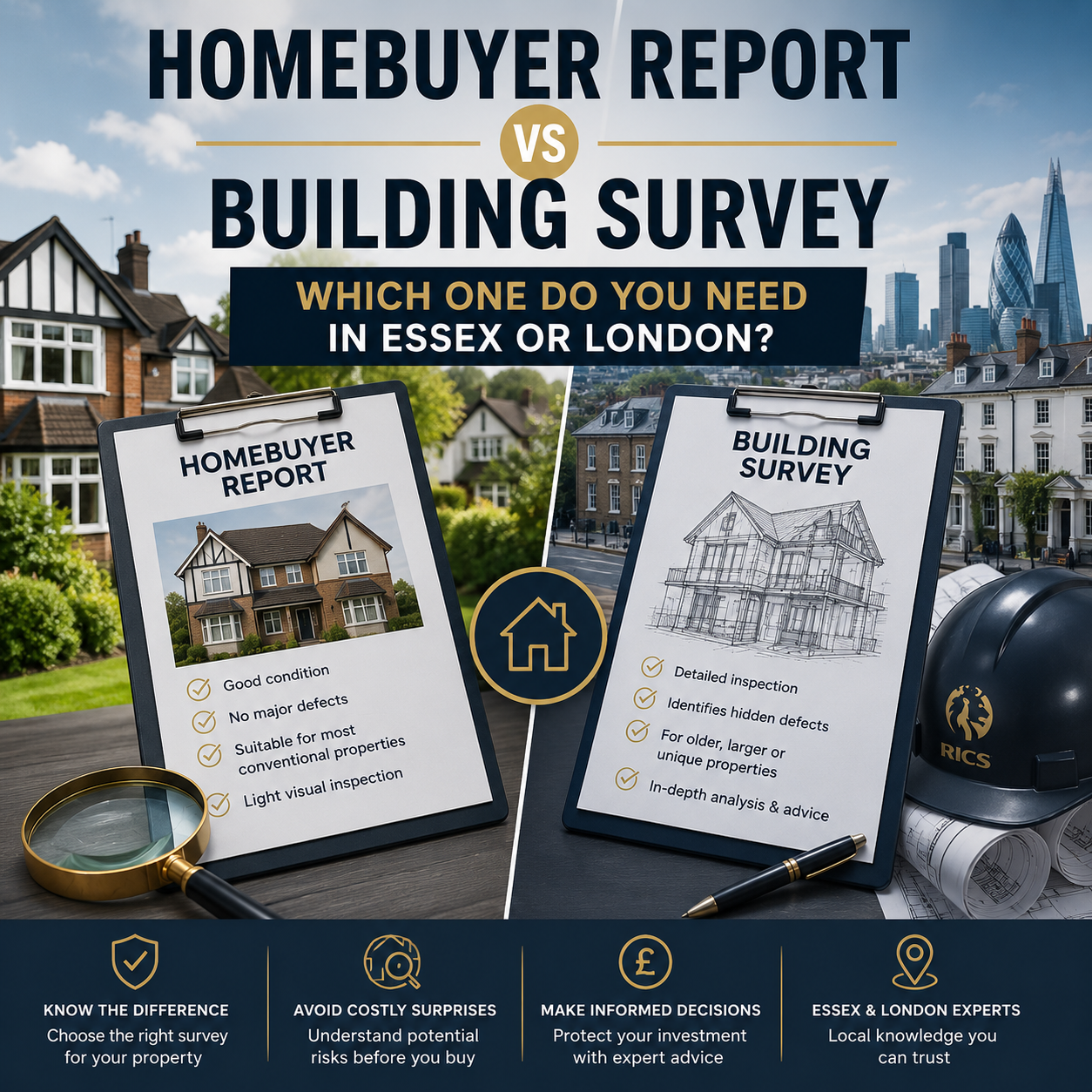
Buying a home is exciting, but it’s also one of the biggest financial decisions you’ll ever make. Before signing anything, it’s important to understand exactly what you’re buying — and that’s where the Homebuyer Report vs Building Survey Essex debate becomes important.
If you’ve been researching property surveys, you’ve likely come across the terms Homebuyer Report and Building Survey many times. While they may sound similar, they serve different purposes, and choosing the wrong one could mean overlooking costly structural issues or hidden defects.
In this guide, we’ll break down the Homebuyer Report vs Building Survey Essex comparison in simple terms, helping you decide which survey is right for your property — whether you’re buying a modern apartment in East London or a period cottage in rural Essex.
What Is a Homebuyer Report?
A Homebuyer Report (officially called a RICS Level 2 Home Survey) is the most popular type of survey in the UK. It’s a visual check carried out by a qualified surveyor who looks at the condition of the property without lifting floorboards, moving furniture, or going into areas that aren’t easily accessible.
It’s designed for properties that are:
- Built in the last 100 years or so
- Made from standard materials like brick, block, or tile
- In reasonably good condition
- Free from major extensions, alterations, or unusual layouts
What’s Included in a Homebuyer Report
- A condition rating for each part of the property (walls, roof, windows, etc.), shown using a simple traffic light system
- A check of the loft space, where accessible
- Comments on damp, woodworm, and subsidence if visible
- General advice on repairs and ongoing maintenance
- An optional market valuation (you usually need to ask for this separately)
It’s a straightforward report, often around 20 to 30 pages, written in plain language rather than technical jargon.
What Is a Building Survey?
A Building Survey (officially the RICS Level 3 Home Survey, previously known as a Full Structural Survey) is the most detailed inspection a surveyor can carry out. Instead of a general overview, it digs much deeper into how the building was constructed, what’s gone wrong, why it’s gone wrong, and what it will cost to fix.
This is the survey to choose for properties that are:
- Older (Victorian, Edwardian, Georgian, or earlier)
- Listed buildings or in a conservation area
- Built from non-standard materials, like timber frames or thatch
- Extended, converted, or altered multiple times
- Showing visible signs of damage, movement, or disrepair
- Properties you’re planning to renovate
What’s Included in a Building Survey
- A full inspection of every accessible part of the building, including roof voids, basements, and outbuildings
- Detailed explanations of defects, their likely causes, and how urgent they are
- Advice on repair options and approximate costs
- Comments on the building’s construction and any past alterations
- A much longer, more technical report, often 50 pages or more
A Building Survey doesn’t usually include a market valuation. If you need one, you’ll need to ask your surveyor or get a separate mortgage valuation.
Home buyer Report vs Building Survey: The Key Differences
| Homebuyer Report (Level 2) | Building Survey (Level 3) | |
| Best for | Modern, standard properties in good condition | Older, listed, altered, or unusual properties |
| Depth of inspection | General visual check | Detailed, room-by-room inspection |
| Report length | 20–30 pages | 50+ pages |
| Includes valuation | Sometimes, on request | Rarely, usually separate |
| Cost | Lower | Higher |
| Best if you’re renovating | No | Yes |
How Much Do These Surveys Cost?
Survey prices depend on the property’s size, age, value, and location, so always get a few quotes before booking. As a general guide for 2026:
- Homebuyer Reports typically cost between roughly £400 and £800 for most family homes, rising for larger or higher-value properties.
- Building Surveys typically cost between roughly £700 and £1,500, with prices climbing further for large, listed, or complex properties.
Because London property prices tend to be higher than the UK average, survey costs in London are often a bit higher than in Essex too, sometimes by 10–20%. Essex still has plenty of older market towns and villages, so don’t assume a lower house price automatically means a lower survey cost, especially if the property is a period cottage or has unusual features.
It’s worth remembering that a survey usually costs a small fraction of the property price, but it can save you thousands if it uncovers a serious issue before you commit.
Benefits of a Homebuyer Report
- More affordable than a Building Survey
- Quicker turnaround, so it fits well with a faster purchase
- Easy to read, with clear traffic light ratings
- Gives peace of mind for straightforward, modern properties
- Often includes a valuation, helpful for mortgage negotiations
Benefits of a Building Survey
- Far more detailed picture of the property’s true condition
- Identifies hidden or developing problems before they become expensive
- Gives you solid evidence to renegotiate the price if defects are found
- Helps you budget accurately for repairs or renovation work
- Reduces the risk of unexpected costs after you move in
Which Survey Is Best for Different Property Types?
Modern Flats and New Builds (Common Across London)
If you’re buying a flat in a purpose-built block or a relatively new development, a Homebuyer Report is usually enough. These properties are built to current standards and rarely have the structural quirks that need a deeper look.
Victorian and Edwardian Terraces (Common in Both Essex and London)
These properties are everywhere in London boroughs like Walthamstow, Leyton, and Ilford, as well as towns across Essex like Colchester and Southend. Many have had extensions, loft conversions, or damp issues over the years. A Building Survey is the safer choice here.
Period Cottages and Listed Buildings (Common in Rural Essex)
Villages across Essex have a lot of older, characterful homes, sometimes timber-framed or listed. These properties often come with hidden surprises, from outdated wiring to structural movement. A Building Survey is strongly recommended.
Converted Properties (Common in Both Areas)
Old houses split into flats, former commercial buildings turned into homes, or barn conversions all fall into a grey area. If the building has been significantly altered from its original form, go for a Building Survey to understand exactly what was done and how well.
Properties You Plan to Renovate
If you’re buying with renovation in mind, whether it’s a fixer-upper in Essex or an older terrace in London, a Building Survey gives you the detail you need to plan and budget properly before you start knocking down walls.
Practical Advice for Homebuyers in Essex and London
- Don’t rely on the mortgage valuation. Your lender’s valuation only checks the property is worth the loan amount. It is not a substitute for a proper survey and won’t tell you about hidden defects.
- Ask the surveyor questions before booking. A good surveyor will happily discuss the property’s age and likely issues over the phone before you commit.
- Choose a RICS-registered surveyor. Look for the letters MRICS or FRICS after their name, this means they’re properly qualified and regulated.
- Get a few quotes. Prices can vary a fair amount between surveyors covering the same area, so it’s worth comparing.
- Read the full report, not just the summary. The traffic light ratings are useful, but the detail underneath often explains how serious an issue really is.
- Use the findings to negotiate. If a survey turns up problems, you can often ask the seller to reduce the price or fix the issue before completion.
- When in doubt, go bigger. If you’re unsure whether your property needs a Homebuyer Report or a Building Survey, the extra cost of stepping up to Level 3 is usually small compared to the risk of missing something important.
Final Thoughts
There’s no single “best” survey, it depends entirely on the property you’re buying. A modern flat in London might only need a Homebuyer Report, while a charming old cottage in the Essex countryside is much safer with a full Building Survey. When you’re not sure which one fits, ask a RICS surveyor to look at the property’s age, condition, and history, and let that guide your decision rather than the price difference alone.
Spending a bit more time and money upfront on the right building survey can save you a lot of stress, and money, down the line.
Frequently Asked Questions
- Is a survey legally required when buying a house in the UK?
No. There’s no legal requirement to get a survey in England, but it’s strongly recommended, since it’s the only way to know the true condition of the property before you buy. - Can I skip the survey if the property looks fine?
You can, but it’s risky. Many serious issues, like damp, subsidence, or roof problems, aren’t obvious during a normal viewing. - Which survey should I choose for a property built in the last 10 years?
A Homebuyer Report is usually enough for newer properties, as they’re built to current standards and less likely to have hidden structural issues. - Are survey costs higher in London than in Essex?
Generally, yes, mainly because London property prices are higher, and survey fees often scale with property value. However, an older or unusual property in Essex can still cost more to survey than a standard London flat. - Can I use the survey report to negotiate the price?
Yes. If the survey finds defects, many buyers use this to ask the seller for a price reduction or to have repairs done before completion. - Does a Building Survey include a valuation?
Not usually. Building Surveys focus purely on condition. If you need a valuation too, ask your surveyor to add one, or arrange a separate mortgage valuation. - How long does each survey take?
A Homebuyer Report usually takes a few hours on-site, while a Building Survey can take a full day or more, depending on the size and complexity of the property. - Who arranges and pays for the survey?
The buyer arranges and pays for the survey, usually after their offer has been accepted by the seller.